Miguel Valverde, a Life of Art in the Desert
By: Eero Schauman, Skyline Contributor
ALPINE – I recently spoke with prominent Mexican artist, Miguel Valverde, whose work is currently featured in the Museum of the Big Bend. Valverde spoke about the cultural importance of his work, influences on his life, his artistic process, and on some of the intended symbolism behind his pieces.
As a youth in Mexico, Valverde had asthma, making many physical activities difficult, but something he loved was the luchador, Mexican wrestling. Every Saturday, Valverde could be seen in front of the television set at his abuela’s house, eagerly waiting for the stylized and sensational wrestling matches to begin.
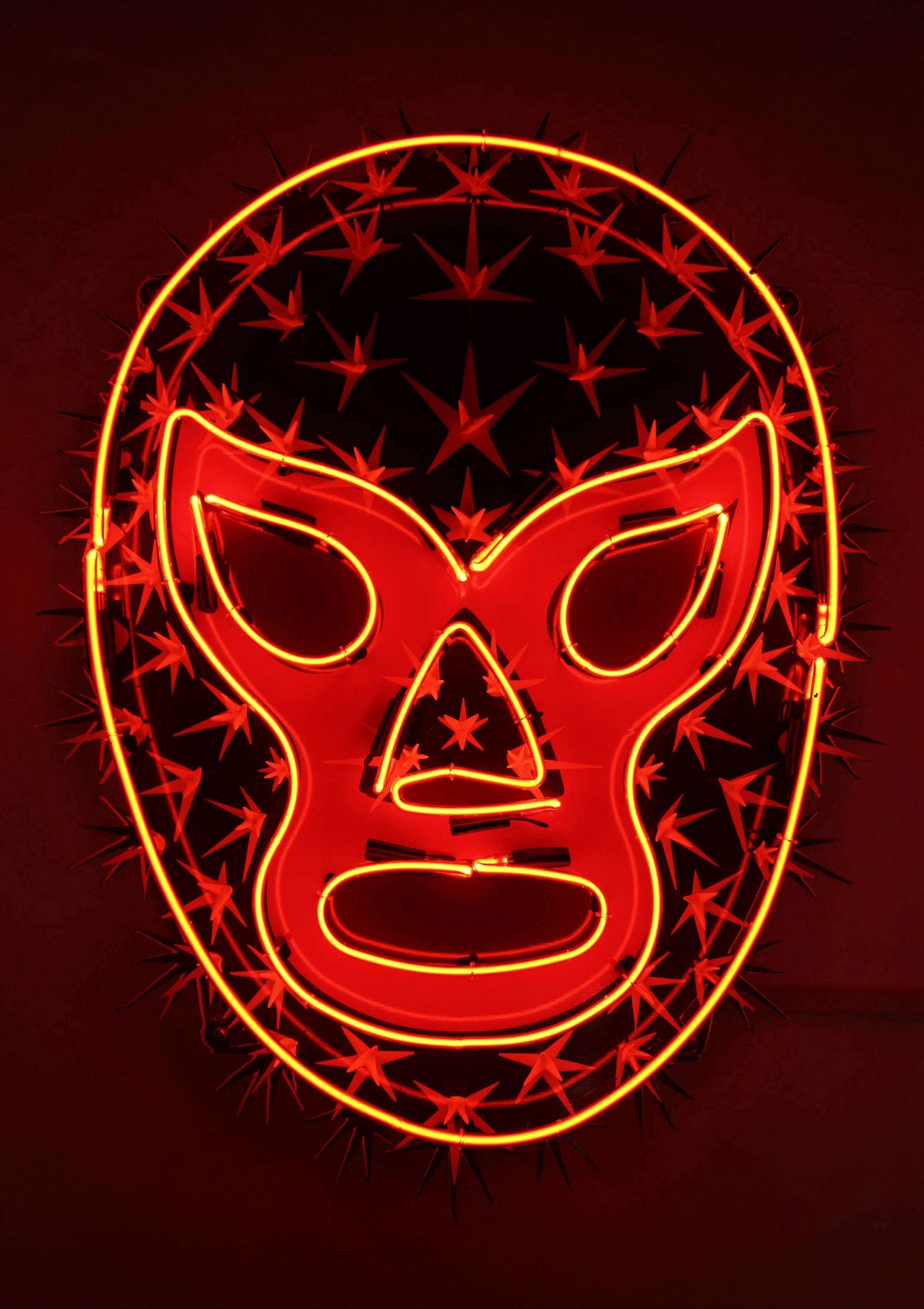
As he grew older and began creating art, the luchador mask and its symbolism became central to much of what he produced. In his words, it’s about the connection between heart and mind, the push and pull between the two, the balance, and the interplay between the warrior and his feelings. This is most evidently seen in a piece he did in Neon, Corazon Solar, a bright reddish orange, pulsing with energy, vibrance, and power.
When I asked about the prominent use of neon lights in many of his works, Valverde stressed that it was the best way to show the power, flow, and energy intended to be felt by the piece, and that he enjoyed working with it.
We discussed his more traditional paintings, like Perla Del Desierto, and Memorias Del Cosmos. For these he wanted to express a deep connection to the Chihuahua Desert, past, present, and future.
Perla Del Desierto depicts a serpent, covered in thorns and spines like the cacti of the desert he calls home, and an ornate pearl for an eye. Not only does this piece represent “the connection between flora and fauna” Valverde said, but the pearl is a symbol of protection of the desert. The piece also shares its name with Ojinaga, Mexico, and the artwork is very representative of the region. When asked about the depiction of a whale in Memorias Del Cosmos, in a collection largely featuring desert fauna and flora, Valverde said it was a connection to the past, inspired in Baja, California, to the oceans that used to cover what is now desert.
The most interesting thing to hear, as an artist myself, was Valverde’s artistic process.
“My artistic process combines intuition and structure,” he said, “I do not usually leap into the void without a clear idea, but I also avoid rigid systems… drawing is the origin of almost everything I do…” which is great to hear for many artists, who struggle with structure and focus.
Miguel Valverde’s work is being featured at the Museum of the Big Bend until Saturday, Feb. 28.